
As we discussed last time (see the Index), Coleman Hawkins was the first to record solo saxophone improvisations without piano accompaniment. We showed that the only other solo sax discs were three instances of people practicing that, in any case, were never intended to be shared with the public. And we heard the first solo sax pieces, “Hawk’s Variations 1 and 2,” which I showed were recorded in N.Y.C., January 11, 1945. Those were available only in Europe for many years. But “Picasso,” which we will discuss today, is by far the best known of Hawkins’s solo sax recordings. After all, it was released in the U.S.A. in December 1949 by the famous producer Norman Granz in a celebrated multi-78 (now multi-CD) set containing many top artists. And although it was first issued as a limited edition, a few years later a 2-LP version became available internationally. In fact, “Picasso” is probably second in fame only to “Body and Soul” among Hawkins’s recordings.
Now, as I showed, “Hawk’s Variations, Part 2” is actually an astounding and early performance of Monk’s “‘Round Midnight.” But Part 1 is completely unrelated to that and appears to be a free improvisation. It has generally been assumed that “Picasso” is also a free improvisation. According to Gunther Schuller, in his 1989 book The Swing Era, “Picasso” “is a free-form, free-association continuity.” John Chilton, one of the best jazz researchers ever and a trumpeter himself, wrote in his Hawkins bio, the only full-length one to date, that “Picasso” “is positively avant-garde. It involves the presentation of thirty-seven phrases that are unconnected by harmonic progression or tempo…not based on any standard harmonic progression.” (p.261).
But in fact Brian Priestley has noted for years that “Picasso” is Hawkins’s version of a song called “Prisoner of Love.” And today Brian will prove it once and for all, by letting me present his evidence. First, let me state his credentials. Brian Priestley (not Priestly, as it is often misspelled), based in the U.K., is one the best jazz scholars anywhere, an excellent musician, and the author of highly respected books on Mingus, Parker and others. He has also published seven books of accurate piano solo transcriptions, and was a key author of the Rough Guide to Jazz, one of the best biographical encyclopedias.
Hawkins himself liked to downplay the amount of preparation that went into “Picasso.” In fact, he told the Duke Ellington Society in February 1969, “It came out spontaneously, that morning” (Chilton, p.261). But the producer, Norman Granz, described a long process. First, he said, Hawkins wanted to play “’Round Midnight,” but he dropped that idea after spending a long session working on it, partly on piano. (Sorry, I cannot at the moment find the source for this.) If this is correct, it is especially significant because we know now that “Hawk’s Variations 2” is indeed ‘“Round Midnight.” It appears that Hawkins was not satisfied with either of the “Variations,” as we will discuss next time. So this was his chance to do it over to his own satisfaction. (As we saw, both “Variations” finally came out in February 1950, two months after “Picasso.”) But for some reason Hawkins, Granz, or both decided that Monk’s song would not work.
So what happened next? In the original Jazz Scene liner notes, Granz says that there were two more recording sessions. This did not include the one devoted to ‘Round Midnight”— Granz says that they worked on just one piece in both of these sessions, the one that became “Picasso.” His exact words are: “When we recorded this side, Hawkins sat down and for two hours worked it all out on the piano. He then recorded it on the tenor for another two hours. Always the perfectionist, he still wasn’t satisfied; so a month later we recorded the piece again, and finally, after another four-hour session, got the take we wanted.”
Wait a second! He said that Hawkins “worked it all out on the piano.” What did he work out? It could only have been the chord progression. Even if he had the sheet music, which is possible because he used the original key of Eb, he still had to study the chords in order to get ideas for his solo. That proves that this was not a “free improvisation.” And it’s worth noting that elsewhere (I can’t recall where), Granz said that they had made eleven takes of “Picasso”—it’s not clear if that included the released performance—which, if it were completely free, would probably not have been necessary. (Sadly, not one of those other takes, which were on discs—the only technology then available—was preserved.)
So, let’s examine the song “Prisoner of Love,” and then we’ll ask Brian to illustrate that it is the basis of “Picasso.” “Prisoner of Love” was composed by Leo Robin, Clarence Gaskill, and singer-songwriter Russ Columbo. Columbo recorded it on October 9, 1931 and it was copyrighted on October 19. Here is the original sheet music:

It received a number of recordings over the years, and suddenly there was a flurry of recordings during 1946 that Hawkins would certainly have known: Billy Eckstine’s, released in February 1946, was a #10 hit, and then Perry Como’s, released March 1946, reached number one! And this led to recordings by the Ink Spots and by Gordon McRae the same year. But the song was quickly forgotten, as often happens. Bands continued to perform it at gigs and on radio broadcasts, but I only know of one commercial recording in 1947, and the next one is from 1954.
Almost all recorded versions, at least online, play in the key of D. Only the popular version by the Black vocal quartet The Ink Spots, released in May 1946 and a #9 hit, plays in Eb, the original sheet music key and the one that Hawkins uses. So maybe that was his model. Let’s listen—the fine piano work is by Ray Tunia.
As you will notice below, it’s very difficult to recognize that this is the song that Hawkins is playing. Why? Partly for the simple reason that he starts with an introduction, and one doesn’t know when “Prisoner of Love” begins. And of course, because unlike Brian, most of us do not know this song by heart. Here is a leadsheet that happens to match not perfectly, but pretty well, with the chords that Hawkins plays (the Ink Spots use fewer chords):
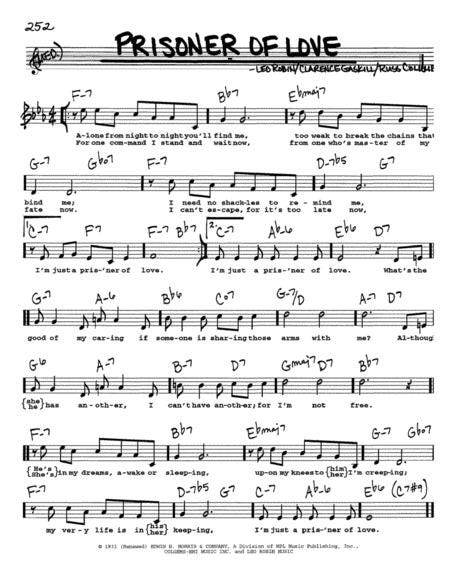
To get our ears accustomed, Brian suggested that we listen to one chorus of “Picasso” while I play the chords on my Yamaha digital piano. I’m using the leadsheet, but loosely, adapting to what Hawkins plays as best I can. The first A section starts at 0:13; second A at 0:47, and the bridge at 1:20—I stopped before the end of the bridge, but I think there is plenty here for you to confirm that Hawkins’s solo works with the chords of “Prisoner”:
As Priestley points out, the biggest proof is that even though Hawkins is playing primarily in Eb, he goes to G minor for the start of the bridge at 1:20, and at 1:34 he switches to G major for the middle of the bridge, which is a very distinctive and unusual feature of “Prisoner.” In fact, Brian notes that at 1:25 Hawkins plays a B-natural, which doesn’t work for the G minor tonality at that point, and then immediately goes back to B-flat. This is real evidence that he has the song in his mind and is not just playing “whatever he wants.”
As another illustration of the connection between “Picasso” and “Prisoner of Love,” I had the idea to combine Hawkins’s solo with the Ink Spots. I paused the vocalists when needed, to stay in synch with Hawkins. I left off Hawkins’s introduction, and once again, I only got up to almost the end of the bridge, but you’ll hear the connection clearly:
One more thing—Brian suggested that you might want to listen to the only other Hawkins recording of this song, on an album with Ben Webster in 1957. (Hawkins recorded it the next year with Milt Jackson, but for unknown reasons that version was never issued.)
Now we’re finally ready to hear “Picasso.” All versions online run slightly sharp except the one from the original 78 rpm disc, which is what I used throughout this essay. As we noted, the first A section starts at 0:13, and the second A at 0:46. Brian notes that up to now the beat has been free, but when the bridge starts at 1:20, Hawkins is still playing freely but is closer to keeping a tempo. The last A section starts at 1:43. Brian notes that starting at 2:16 it’s a little harder to define what Hawkins is doing—he seems to play an A section, but then from about 2:48 to the end he plays a fairly free coda. I love the bluesy line at 2:34, and the haunting ending. Let’s listen to this masterful performance:
As I told you, Brian Priestley is an excellent musician! It’s amazing that he heard this connection, but now you know that it’s certain and unmistakable.
We are still left with questions: How did it get the name “Picasso,” and where and when was it recorded? I’ll get to those next time.
All the best,
Lewis
P.S. Thanks to Steven Lasker for work on the “Picasso” recording.
I also liked the haunting beginning. Reminded me of 'Round Midnight.
Fascinating stuff, Lewis!
I have a Detroit musicianer who may interest you, what is your email?
Jim Gallert
jamesmacvouty@gmail.com